From the Reviews:
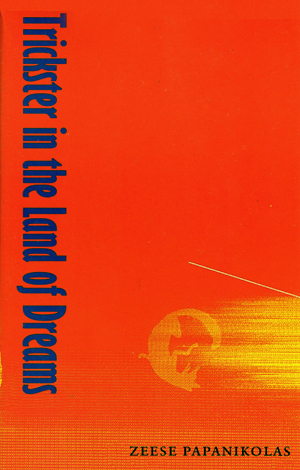
In Trickster in the Land of Dreams, Zeese Papanikolas…peels back the layers of mythology – from American Indian creation fables to propaganda for the MX missile program – that have settled on the harsh desert landscape of the American West.
This might have been a tedious exercise, but Papanikolas approaches it as a tale-spinner, retelling both American Indian lore and modern history and anecdote with easy familiarity…by putting the reader into a dreaming frame of mind it brings home Papanikolas’s point better than any argument could, that America has long taken its own spaciousness for proof that self-invention and individual moral authority are potentially unlimited. We feel the force of that delusion in spite of ourself…The better part of the book is a memorable performance, a kind of delirious anthropology. that will not be easily imitated. Kenneth Baker, The San Francisco Chronicle
This book is exceptional, an important “crossover” book for western studies. It has a fictionalist’s feel for pace and poetry, a high intellectual’s fluency with theory, a trade unionist’s political sensibilities, and a tricktster’s cunning about disciplinary convention. It is one of the first fine cultural studies texts in western history. Krista Comer, Westerm Historical Quarterly
Near the end of his haunting and vital book, Zeese Papanikolas describes what he imagines to be Jean Baudrillard’s drive into the American desert. In America (1986), the Philosopher sees through the windows of his Chrysler one big, metaphysical souvenir—America seen as desert, as panning shot in a movie, as hyperreality, as simulacrum. “Transparent as glass, what can one make of it? It becomes another text.” … As Trickster in the Land of Dreams argues, we do not serve the survival of consciousness within the world by sticking to the desert highways of abstraction, through the disciplined cloistering of professional knowledge. In the folklore of history, rather than the science, we find “meaning that flows backward and forward at once.” Only by engaging with the spiritual yearnings and vernacular terms in which ordinary people perform knowledge in the world can we come to read their experience in a way that is meaningful for our own lives and actions. Thomas Augst, Boston Book Review
From the Book
In a world without fire, on a plain, the creatures of the mythtime are gathered. They have come together for a handgame, or to hunt rabbits. Coyote is there, and Lizard, and Hummingbird with his pretty feathers. But the world in which they gather is a cold place. A lightless place. Back and forth the creatures go on the lightless, limitless plane, chafing themselves, shadows of who they will one day be. We do not know what real fire is, Coyote says. We haven’t been using real fire.
Because a world without fire, like a world without desire, cannot exist. It cannot be conscious of itself. For fire is a kind of speech, a tongue. It is impossible to imagine a story without imagining fire.
✻ ✻ ✻
A tin man, a lion, and a scarecrow walk along a yellow road. The road winds up and down through country that is sometimes settled, but often not. At times the road almost disappears. The little girl and the dog who walk beside them are from another world of experience. Unknown to the tin man, the lion, and the scarecrow is it that what they seek is who they already are; what the little girl and the dog are looking for is the way back to a place stuck in the middle of the map of America called Kansas. But all of them, those odd, animated figures, patched together from the leavings of dim nineteenth-century shops and barns, the lion drawn out of some tattered book of nursery rhymes, the girl and the dog, are going to a city mad of emeralds to achieve their desires.
It is not the fairy-tale witch, her winged monkeys, the terrible Kalidahs, or any of the other menaces along the way that are the real dangers for the travelers. The real dangers are the dark possibilities that swarm up from the holes in the American project, those contradictions between our dreams and the realities out of which such dreams have been born. “It is a long journey, through a country that is sometimes pleasant and sometimes dark and terrible,” the seekers are told of the way to the Emerald City. Those words might well descirbe the search for America itself. Being figures in a story, the Lion, Tin Woodman, Scarecrow, and girl care nothing for that. They have their own troubles to think about. The dog can only sniff and bark.
Available at University of Nebraska Press, at Powells.com, and at Indiebound.org.